

Barnet Dulaney Perkins Eye Center Glaucoma Specialist Publishes New Research on Multimodal Glaucoma Treatment
A new glaucoma study is exploring how two treatment options, iDose TR and MIGS, may work together to help lower eye pressure and reduce the need for daily glaucoma drops in some patients.
The study was led by Christine Funke, MD, a fellowship-trained glaucoma specialist at Barnet Dulaney Perkins Eye Center. It examined early real-world outcomes among patients with open-angle glaucoma who received both iDose TR and MIGS.
After 3 months, researchers found that many treated eyes had lower average eye pressure, used fewer glaucoma medications, and were more likely to be medication-free than before treatment.
“These results are encouraging, but they do not mean every patient with glaucoma can stop using eye drops. Glaucoma treatment is highly personal, and the right plan depends on each patient’s eye pressure, optic nerve health, disease stage, lifestyle, and long-term risk of vision loss”, says Dr. Christine Funke.
Read the complete peer-reviewed study.
Why Glaucoma Treatment Often Requires More Than One Tool
Glaucoma damages the optic nerve, which carries visual information from the eye to the brain. Many forms of glaucoma progress slowly and without obvious early symptoms. Once glaucoma causes vision loss, doctors cannot restore that lost vision.
Prescription eye drops work well for many patients, but they must be used consistently and may not lower pressure enough on their own over time. Treatment may include laser therapy, iDose TR, MIGS, or traditional glaucoma surgery. Your doctor will recommend options based on your eye pressure goals, glaucoma severity, and overall eye health. Using more than one approach can give your glaucoma specialist additional ways to control eye pressure and build a plan that fits your eyes and daily routine.
What Did The New Glaucoma Study Examine?
Dr. Funke and co-author Chloe CoHan reviewed outcomes in 107 eyes from 75 adults with open-angle glaucoma.
Each eye received the iDose®TR travoprost implant together with one of two microinvasive glaucoma procedures:
- iStent infinite implantation
- Canaloplasty
Some patients received the glaucoma treatments during cataract surgery. Others received the glaucoma treatments without cataract surgery.
Researchers compared intraocular pressure and use of topical glaucoma medications before treatment and at three months afterward. They also reviewed outcomes by type of glaucoma procedure and whether cataract surgery was performed at the same time.
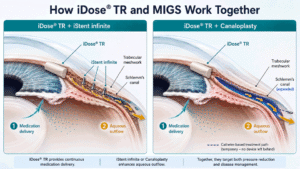
The study evaluated a multimodal approach that combines treatments that lower intraocular pressure in different ways. In this case, iDose® TR delivers medication inside the eye, while MIGS helps improve the eye’s natural fluid drainage.
What is iDose®TR?
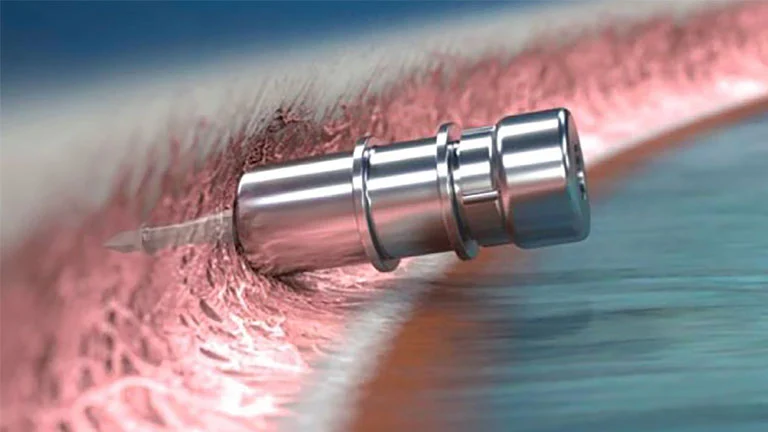
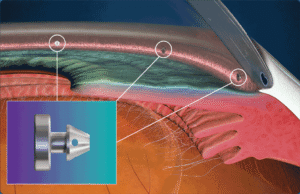
iDose®TR is a small implant placed inside the eye. It continuously releases travoprost, a prescription medication that helps lower eye pressure.
The United States Food and Drug Administration has approved iDose®TR for reducing eye pressure in patients with open-angle glaucoma or ocular hypertension.
Unlike topical eye drops, the implant delivers medication from inside the eye. This removes the need for the patient to remember and administer that particular medication every day.
However, iDose®TR does not guarantee that a patient will become completely free from glaucoma drops. Some patients may still need additional medication, laser treatment, surgery, or another therapy to reach their target pressure
What Is MIGS?
MIGS, or microinvasive glaucoma surgery, refers to a group of procedures designed to lower eye pressure through smaller openings and less tissue disruption than traditional glaucoma surgery.
The two MIGS approaches examined in this study were iStent Infinite and canaloplasty.
iStent Infinite
The iStent Infinite system uses tiny stents placed in the eye’s drainage pathway. The goal is to help fluid move through the trabecular meshwork and Schlemm’s canal more efficiently.
Canaloplasty
Canaloplasty uses a small catheter to access and expand Schlemm’s canal, part of the eye’s natural drainage system. Improving this pathway may help fluid leave the eye more effectively.
Both procedures address fluid drainage. iDose TR® lowers intraocular pressure by delivering medication directly into the eye. Combining the treatments allows the doctor to address eye pressure through multiple pathways.
What Were The Main Study Results?
The researchers reported several notable changes three months after treatment.
Average Eye Pressure Decreased
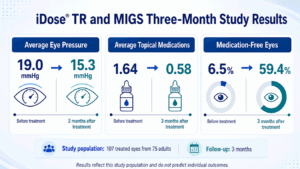
Across all 107 treated eyes, average eye pressure decreased from 19.0 mmHg before treatment to 15.3 mmHg after three months.
The study also reported significant average pressure reductions in the larger groups of eyes treated with and without concurrent cataract surgery.
Average Medication Use Decreased
Before treatment, patients used an average of 1.64 topical eye-pressure medications.
After three months, that average decreased to 0.58 medications.
This does not mean every patient stopped every drop. It means the overall number of topical pressure-lowering medications fell across the study group.
More Eyes Were Medication-Free At Three Months
Before treatment, 6.5% of the studied eyes were not using topical pressure-lowering medication.
At the three-month follow-up, 59.4% were medication-free.
Among eyes treated during cataract surgery, 67.7% were medication-free after three months. Among eyes treated without cataract surgery, 46.3% were medication-free.
These percentages describe the patients included in this particular study. They do not predict an individual patient’s outcome.
What Do These Results Mean For Patients?
The findings suggest that iDose®TR and MIGS may help selected patients lower eye pressure while reducing the burden of topical glaucoma medication.
That could matter for patients who:
- Have difficulty remembering daily drops
- Struggle to place drops correctly
- Experience irritation or other medication side effects
- Use several pressure-lowering medications
- Need steadier medication delivery
- Have glaucoma and cataracts
- May benefit from a combined treatment plan
Reducing the number of daily drops may also make a treatment routine easier to manage. However, convenience is not the only goal. The treatment must also lower pressure enough to protect the optic nerve.
A patient who becomes medication-free still needs regular eye-pressure checks, optic nerve imaging, visual field testing, and long-term glaucoma care.
Why Combine iDose®TR With MIGS?
Glaucoma treatment often works best when doctors match several strategies to the needs of one eye.
iDose®TR delivers pressure-lowering medication internally. MIGS procedures help improve fluid drainage. Because they work differently, the treatments may provide complementary pressure control.
Think of it as addressing a traffic problem from two directions. One treatment changes how pressure-lowering medication reaches the eye. The other helps create a clearer path for fluid to flow out.
This approach may be especially useful when a patient needs more control than a single treatment can provide.
“Glaucoma is a lifelong disease, and many patients need more than one tool to control eye pressure over time. Our early real-world findings suggest that combining treatments that work in different ways may help appropriately selected patients lower eye pressure while reducing their reliance on daily drops. These results are encouraging, and continued follow-up will help us better understand the long-term role of this approach.” – Christine Funke, MD
What Did The Study Find About Safety?
The researchers reported one intraoperative adverse event. An endothelial detachment occurred during canaloplasty and was repaired in situ. The report states that no additional surgery or lasting complications resulted from that event.
The researchers reported no postoperative adverse events during the three-month follow-up period.
These early findings are reassuring, but every eye procedure carries potential risks. Risks vary by treatment and may include inflammation, bleeding, infection, pressure that becomes too serious or too low, corneal problems, or the need for additional treatment.
A glaucoma specialist should explain the expected benefits, alternatives, and risks before recommending a procedure.
 Dr. Christine Funke’s Role In The Research
Dr. Christine Funke conceived and designed the study, performed the procedures, supervised the research, and contributed to the manuscript.
She is a board-certified ophthalmologist and fellowship-trained glaucoma specialist at Barnet Dulaney Perkins Eye Center. Her clinical work includes MIGS, drug-eluting glaucoma devices, tube shunts, cataract surgery, and combined cataract and glaucoma procedures.
Dr. Funke provides care at Barnet Dulaney Perkins Eye Center locations in Chandler, Mesa, and Sun City. Patients can learn more about Dr. Christine Funke and her approach to glaucoma care.
Ask About Your Glaucoma Treatment Options
Glaucoma can progress without pain or noticeable early warning signs. Regular monitoring and timely treatment can help protect the vision you still have.
Barnet Dulaney Perkins Eye Center provides glaucoma testing and advanced treatment options across Arizona, including care from fellowship-trained glaucoma specialists in the Phoenix Metro area and communities throughout the state.
Schedule a glaucoma evaluation at Barnet Dulaney Perkins Eye Center today to learn which treatment options may fit your eyes, your health, and your long-term vision needs.
Study Disclosure
**The study received no external research funding. Glaukos funded editorial assistance, the publication fee, and the journal’s Rapid Service fee. Dr. Christine Funke reports consulting and speaking relationships with Glaukos. Complete author disclosures are available in the published study.